 Pickleball’s meteoric rise — from neighborhood courts to sold-out professional arenas — has created new opportunities at the intersection of recreation, wellness, and sports medicine.
As participation surges across all ages, chiropractors are uniquely positioned to lead both on and off the court, supporting performance, preventing injury, and strengthening communities through accessible care. At Palmer College of Chiropractic, recreational sports culture and an expanding focus on sports rehabilitation are advancing student wellness while preparing future doctors for real-world opportunities in emerging athletic spaces.
Together, pickleball and chiropractic care illustrate how modern sports demand integrated, movement- focused health care — and how Palmer graduates are helping shape what comes next.
Palmer grad is keeping pickleball pros in the game
Riley Newman thought his tournament was over.
It was the opening week of the season, a new tournament, new partners, and the Brooklyn Pickleball Team’s first major test of the year. Newman — then a top-10–ranked professional pickleball player in the world — had torn his right groin and aggravated his hip flexor. Acceleration was painful. Defense, his calling card, was nearly impossible.
Then “Dr. Paul” stepped in.
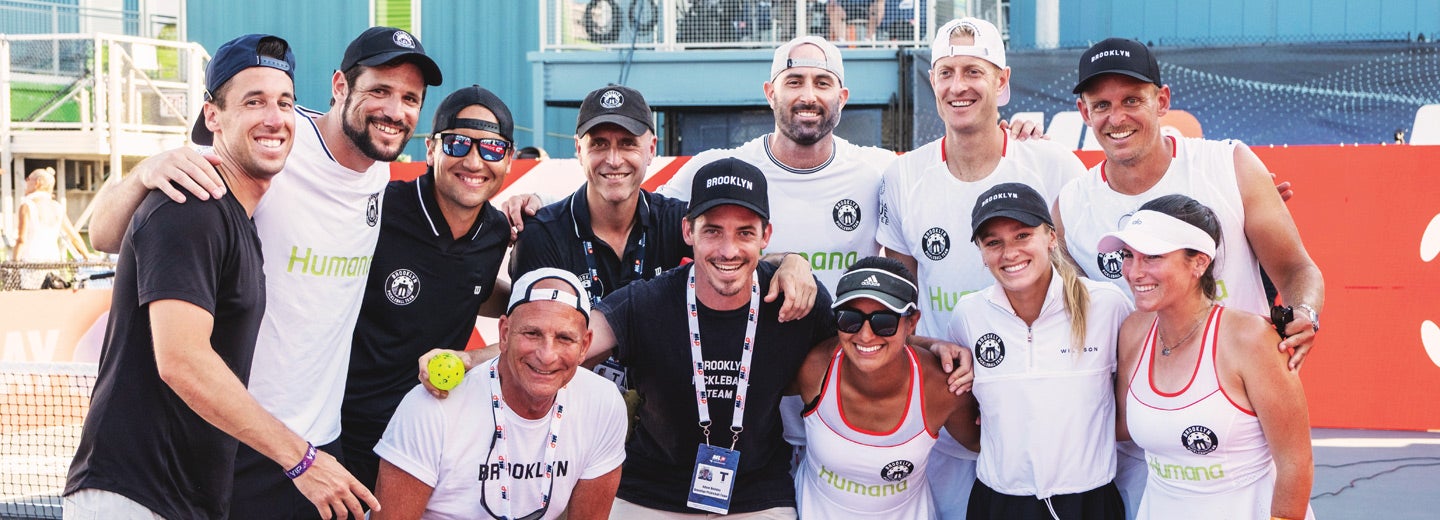
Paul Trinkoff, D.C. (`87) was able to examine Newman, diagnose the issue, and create a treatment plan that included advanced soft tissue therapy. By the weekend, Newman was back on the court, and Brooklyn didn’t just survive the tournament — they won it.
“If it wasn’t for Paul, I wouldn’t have been able to play,” Newman says. “I was blown away by how fast everything came together.”
That moment set the tone for what has become a landmark appointment in professional pickleball. After a 38-year chiropractic career, Dr. Trinkoff became the first official team chiropractor and doctor for the Brooklyn Pickleball Team, a Major League Pickleball (MLP) franchise stacked with elite talent and backed by high-profile owners. His role reflects both the explosive growth of the sport and the expanding leadership opportunities for chiropractors within it.
Dr. Trinkoff’s path to the Brooklyn Pickleball Team was built on longevity, adaptability, and trust. He has maintained a private practice in New York for nearly four decades, treating everyone from infants to centenarians, recreational athletes to professionals. His philosophy has remained consistent: chiropractic care is about taking care of people, not just their injuries.
“We’re doctors,” Dr. Trinkoff says. “We work with medical teams. We triage, we coordinate, and we connect patients with the right people when needed. It goes beyond adjustments. It’s about outcomes, and that includes creating community.”
That mindset made him a natural fit for pickleball, a sport that is fast, unpredictable, and deceptively demanding on the body. After 13 knee operations and a replacement in 2021, Dr. Trinkoff found pickleball himself, initially as a way to stay active without the pounding of tennis. He quickly became competitive, winning state and senior Olympic titles and immersing himself in the pickleball community.
Through that community, Dr. Trinkoff met Brooklyn Pickleball Chief Operating Officer Adam Behnke. What started as a casual meeting quickly became something deeper. “It was an immediate match,” says Behnke. “We want to be the Yankees of pickleball. That means having the best people, and people we trust completely. That meant bringing in Paul.”
Behnke has watched the sport professionalize in real time. Early on, many players came straight “off the couch.” Today, prevention, recovery, and day-to-day readiness are essential for team success and for the league’s future.
“Keeping our stars healthy is critical,” Behnke says. “It’s critical for our team, and for the growth of the sport. Paul keeps our players on the court. If not for him, we wouldn’t have made the playoffs last year. I’m constantly amazed by what he does.”
The game is growing, and chiropractors are leading the way
At the professional level, pickleball rallies are long, reaction times are razor-thin, and biomechanics must be precise. Players bend, lunge, and hold extreme postures at the kitchen line (the non-volley zone near the net), often without predictable movement patterns. “If you blink, you’ve missed it,” Newman says. “The speed is incredible. Having someone in your corner who knows your body makes a huge difference for both preparation and recovery.”
For Kyle McKenzie, head coach of Brooklyn Pickleball, chiropractic care has become integral to coaching strategy. He works closely with Dr. Trinkoff to analyze mechanics, posture, and movement efficiency, factors that often decide matches at the highest level. “Pickleball is new, and team-based leagues are new,” McKenzie says. “Having a medical professional who understands biomechanics and can streamline recovery is huge. Time is everything for a pro athlete.”
What sets Dr. Trinkoff apart, according to Brooklyn’s leadership, is not just the hands-on care but also his emphasis on communication and continuity. “Paul knows the players as people first, then patients,” McKenzie says. “He’s one of our team’s biggest cheerleaders. That matters for culture, confidence, and performance.”
Dr. Trinkoff sees that relational strength as one of the profession’s greatest assets. Chiropractors see patients repeatedly, explain complex issues in plain language, and build trust over time — skills that translate seamlessly into team environments.
“What chiropractor hasn’t dreamed of being the doc for a pro team?” Dr. Trinkoff laughs. “Because of how fast this sport is growing, there’s now a real chance for local chiropractors to get involved. I’ve never been more excited about my career and what I can do for my patients.”
Pickleball’s accessibility — played by ages six to 96 — mirrors chiropractic’s broad reach. Both are community-driven, social, and rooted in movement and wellness. “I’m proud to be an ambassador of the sport and an ambassador for chiropractic,” Dr. Trinkoff says. “I love getting to introduce people to what we can do.”
As a Palmer graduate, Dr. Trinkoff credits his education with giving him the versatility to adapt to patients, not the other way around. His career is a case study in how chiropractic training can open doors far beyond traditional clinical settings.
“Working with elite athletes reinforces the same principles I use every day,” he says. “I help people function at their best level possible, whether they’re world-ranked players or weekend warriors.” For Palmer students and alumni, Dr. Trinkoff’s story underscores a broader message: emerging sports like pickleball are creating new pathways for chiropractors as health care leaders, collaborators, and innovators. And, as always, Palmer is leading the way.
Inside Palmer’s growing sports rehabilitation program
As recreational and competitive sports draw more adults into their 60s, 70s, and beyond, the definition of “sports patient” is changing. At Palmer College of Chiropractic, that shift is shaping how students are trained, especially in sports rehabilitation, where today’s chiropractors must be prepared to care for active bodies across the lifespan.
“At its core, sports rehab is about helping people move better, whether that’s an elite athlete or an 80-year-old who refuses to slow down,” says Associate Professor Trevor Shaw, D.C., M.S., DACRB, CSCS (`10), who leads the rehabilitation and sports performance division at the Palmer Clinic in Port Orange, Florida.
Dr. Shaw, who joined the College’s faculty in 2017, brings a background in strength and conditioning that has helped define the program’s direction. “A lot of doctors stop at pain relief,” he says. “We’re teaching students to bridge the gap between injury and athleticism. We’re helping patients get stronger, faster, and more resilient.”
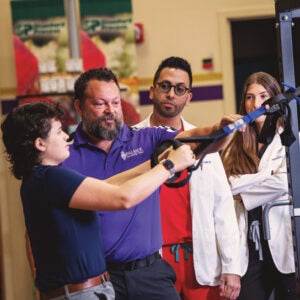
That approach is reflected in the clinic itself. The College’s rehabilitation and sports performance space in Port Orange includes nearly 5,000 square feet of open training space, equipped with passive modalities like shockwave, decompression, ultrasound, cold laser, and e-stim, as well as Rogue racks, bumper plates, and sleds. “It’s designed to look like a strength and conditioning room, not a traditional physical therapy space,” Dr. Shaw explains.
The curriculum has evolved alongside the facilities. “When I was a student, things were very mechanical, and we learned to treat the site of pain,” he says. “Now we emphasize progressive overload and working the entire kinetic chain that is associated with the pain of dysfunction. You must do a little more each day to see real change.”
Technology plays a role as well, with load-monitoring tools helping students track recovery and performance while learning to adjust plans in real time.
These clinical skills are increasingly valuable. Golf is one of the most common activities bringing older adults into the clinic, while partnerships with institutions like Bethune-Cookman University expose students to a wide range of athletic demands. Students also co-manage care with other clinicians, reinforcing chiropractic’s role as a neuromusculoskeletal specialty. “The culture has shifted,” Dr. Shaw reflects. “Students aren’t just curious about rehab, they’re saying, ‘This is my specialty.’ When I was in school, we had a 10-by-10 room. Now they have thousands of square feet and a clear path forward.”
Tips from the Pros
Pickleball may be accessible, but it places real demands on the body. Dr. Trinkoff, Riley Newman, and Coach McKenzie share advice for amateur players looking to stay healthy and improve performance.
“Hydrate throughout the day — one half your bodyweight in ounces of water — and stretch, particularly after playing. Before pro players even step on the court, they’ve already been moving for at least an hour. If you skip hydration and stretching, you’re hurting yourself in the short and long term.” — Paul Trinkoff, D.C. (`87)
“Listen to your body. Pain isn’t something to play through. If you’re hurting, there’s a reason — address it early. On the court, control your movement. The kitchen line isn’t a destination if you’re off balance.” — Kyle McKenzie, head coach, Brooklyn Pickleball
“Take 10–15 minutes after play to cool down. It makes a big difference over time. As you practice, spend time on skills and drills before jumping into games. Balance matters.” — Riley Newman, top professional pickleball player
Dinks between classes
 On any given afternoon, the sound of a plastic ball popping off paddles echoes through Palmer College of Chiropractic’s R. Richard Bittner Athletic & Recreation Center in Davenport, Iowa. What started as a casual way to unwind has grown into a vibrant pickleball scene that brings together students, faculty, and staff as they build friendships, ease academic pressure, and add another dimension to the Palmer experience.
“For students here, the work is relentless,” says Patrik Schneider, D.C. (`14), a faculty member who first played pickleball decades ago and rediscovered the game at Palmer. “Pickleball is the perfect release.”
Dr. Schneider points to Palmer’s intentional investment in recreation as a key factor. The College devotes significant gym space to pickleball courts, provides paddles and balls, and makes it easy for anyone to jump in. “You can play in street clothes,” he says. “The equipment is ready. The barrier to entry is really low.”
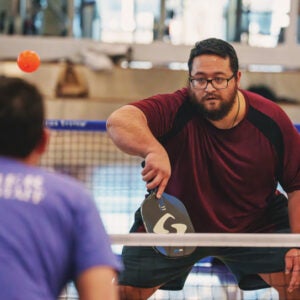
That accessibility is exactly what drew Student Justin Togisala (above) to the courts. “I actually discovered pickleball at Palmer,” he says. “I’ve met so many people through it. Students, faculty, and even people beyond campus. People I never would’ve met otherwise, including lots of chiropractors.”
Justin, an Olympic weightlifting competitor, credits pickleball as both a stress reliever and a serious workout. “It’s a lot of cardio,” he laughs. “It’s been huge for my life balance, especially with how demanding our program is.”
While the Palmer Pickleball Club isn’t officially chartered, it’s highly organized. Drop-in play runs several days a week, tournaments happen about once a trimester, and as many as 30 to 50 people cycle through the courts. “The courts are always full, but always welcoming,” Justin says.
For Student Tristan Fell, pickleball quickly became central to his Palmer social life. “Most of my Palmer friends I met playing,” he says. “Relationships develop on the court.”
Tristan especially values the chance to play alongside faculty. “You’ll play with an instructor, maybe get a good smash on them, then see them in class later,” he says. “It’s fun to see them out there. They feel more human.”
That human connection is exactly the point, Dr. Schneider says. “It breaks down the student-faculty barrier,” he explains. “It builds trust and creates the community feeling that’s at the core of Palmer.”