The world of higher education has never been static. Neither has Palmer College of Chiropractic.
Higher education is undergoing a period of significant change. For professional programs like the Doctor of Chiropractic, these changes directly affect how students access and pay for their education. From navigating new federal loan limits to strengthening academic pathways to expanding philanthropic support, Palmer has responded with a steadfast commitment to keeping a chiropractic education attainable, relevant, and valuable for current and future students. College leaders have been preparing for this moment with intention and foresight by analyzing data, anticipating challenges, and making strategic decisions behind the scenes. Now, they are sharing that work with alumni.
This section of Palmer Proud offers a clear look at where the College stands and invites the Palmer Nation to step forward and help secure a strong future for Palmer and the profession.
While others react, Palmer remains proactive
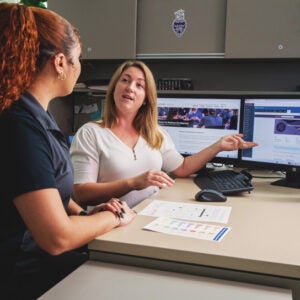 “This is not a moment of surprise for us,” says Michael Norris, Ph.D., vice chancellor of admissions. “It’s a moment we’ve been watching come into focus for some time. It’s a moment Palmer College is prepared for.”
Across higher education, institutions are navigating what many leaders describe as an unprecedented convergence of forces nationwide: demographic shifts, declining enrollments, rising operating costs, and a growing political emphasis on return on investment. Fewer students means more competition. And, for professional programs like chiropractic, those pressures intensified with the passage of the One Big Beautiful Bill Act, a sweeping federal reconciliation bill that significantly alters student loan policy.
Among the bill’s most consequential provisions is the elimination of Grad PLUS Loans and the introduction of new borrowing caps for professional students — $50,000 per year and $200,000 lifetime — significantly below the estimated total cost of a chiropractic education. For Palmer, where Grad PLUS loans represented 23 percent of total loan disbursements last fiscal year, totaling $23.5 million, the implications are substantial. Roughly 63 percent of Palmer students rely on Grad PLUS funding.
“The legislation reflects a broader shift in how our government and culture view higher education,” says Abbey Nagle-Kuch, dean of student affairs. “This has been building for a long time — looking at education through a dollars-and-cents lens — and now it’s becoming tangible for our students.”
At Palmer, the result will be more students looking for private loans, which typically require a higher credit score threshold and come with fewer protections. Private loans can have variable rates, can’t be consolidated, and often require payment before graduation. “The biggest impact is going to be on access,” says Nagle-Kuch. “For those of us in student affairs, there’s a real concern that pathways to professional education for students without significant financial means are narrowing.”
Fortunately, Palmer saw the shift coming and began preparing early. As soon as draft language around Grad PLUS elimination surfaced, leadership engaged the Board of Trustees, modeled multiple scenarios, and deepened collaboration with national advocacy partners like the National Association of Independent Colleges and Universities. “These organizations help translate complex legislation into campus-level impact,” Norris says. “We aren’t doing this work in isolation. We’re getting the best information and using it to support our students and the future of the College.”
Palmer’s response also builds on experience and the strategic direction the College has doubled down on. In recent years, Palmer has seen unprecedented enrollment growth even as overall higher education enrollment declined nationwide. That recovery reinforced what leadership already knew: Palmer’s value proposition, outcomes, and focus on chiropractic education remain strong.
At the same time, under the leadership of the provost and the academic team, Palmer has intensified its focus on strengthening curriculum, assessment, and student support to ensure graduates achieve the highest standards of clinical competence and professional readiness. “Our responsibility is not only to enroll great students, but to ensure they graduate fully prepared to serve patients and lead the profession,” says Dan Weinert, D.C. (`96), provost.
This moment is no different. As always, Palmer has prepared deliberately and decisively for what comes next.
When affordability becomes opportunity
The impacts of federal policy and new academic pathways are often discussed in terms of numbers and structures. But for Palmer College, affordability has never been an abstract equation. It’s been measured in people — in students with the talent and calling to serve and in alumni who once stood in the same place, now positioned to open doors for the next generation.
“The headlines in the world of higher education have reinforced things we’ve always known,” says Clare Thompson, vice chancellor for institutional advancement.
“People want to help people. Higher education changes lives. And Palmer graduates bring those two things together, using their knowledge and generosity to improve the lives of patients and students.”
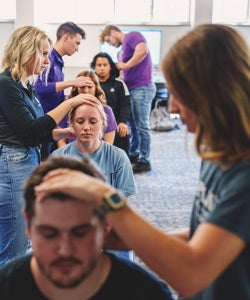 As federal loan structures shift and new limits reshape how professional education is financed, philanthropy has moved from important to indispensable. Alumni support for scholarships and endowments now plays a defining role in keeping a Palmer education attainable today and in the future.
“What sets Palmer apart is our alumni,” Thompson says. “When you line them up, no matter their graduation year, they share a few things in common. They trained at the first and best chiropractic college in the world. They’re exceptional listeners. They have exceptional hands-on technique. And they believe deeply in giving back to benefit the next generation.”
That generosity shows up in tangible ways for students like Kylee Arn, a Palmer student balancing demanding coursework with rising living costs. Tuition is only part of the equation. The cost of rent, food, gas, equipment for classes — even basic clinical tools — adds up quickly.
“Everything costs more right now,” Kylee says. “Scholarships don’t just lower tuition. They reduce stress. They make it possible to stay focused on learning instead of worrying about what has to give.”
Scholarship support can be the difference between working extra hours and being present in clinic, between delaying graduation and staying on track. It can shape the kind of practitioner a student becomes.
Scholarship support can be the difference between working extra hours and being present in clinic, between delaying graduation and staying on track. It can shape the kind of practitioner a student becomes.
Endowed scholarships represent one of Palmer’s most transformative opportunities. Built through multi-year commitments or legacy gifts, they generate annual support for students in perpetuity, creating a lasting investment in access, excellence, and the future of the profession.
“There’s no greater tribute than attaching your name to a scholarship that will support students not just today, but 20 or 50 years from now,” Thompson says. “I believe in the students we haven’t met yet. I know our alumni do too.”
For alumni considering how to respond to this moment, Thompson’s message is simple and confident: Palmer is prepared. Palmer is worthy of investment. And philanthropy remains one of the most powerful ways to ensure chiropractic education stays within reach for every student.
Affordability, trust, and a value that endures
Palmer College of Chiropractic has always endured through stewardship. The College has grown because alumni who believed in its purpose stepped forward to care for it. That responsibility has always extended beyond individual success, toward the collective future of the profession itself.
Few alumni live that commitment more fully than Barry McAlpine, D.C. (`71). A military veteran, longtime practitioner, former Palmer Trustee, and early advocate for advancement at the College, Dr. McAlpine understands Palmer’s value in ways that can’t be reduced to numbers.
College affordability is not a new issue, and it’s not going away, Dr. McAlpine admits. “But tuition, debt, return on investment — those are just part of the conversation,” he adds. “We also need to be talking about character, purpose, and what our students want out of life.”
A Palmer education shapes not only careers, but people. For Dr. McAlpine, supporting Palmer students means ensuring access to the full Palmer experience, setting them on the path for a deeply meaningful life and career.
That conviction led Dr. McAlpine and his family to establish an endowed scholarship in honor of his sister, Gloria McAlpine (`74), whose life and values were closely tied to the College. The choice was a tribute and, the family hopes, something that will inspire others to give. “The gift represents the deep trust I have in the College,” says Dr. McAlpine. “It’s trust in the direction of the school, and it’s a personal trust I have in the people at the helm. These are dedicated, visionary leaders. Because I know them, I’m happy to give a gift for the future.”
Dr. McAlpine’s message to fellow graduates is simple and urgent: now is the time. “Palmer has more than 30,000 alumni,” he says. “Imagine the impact if even a fraction committed to regular giving.
Affordability would improve. Opportunity would expand. And the College would continue to thrive as a place that educates the whole person.”
That team spirit is central to Dr. McAlpine’s vision of success. Success, for him, comes directly from connecting with others and serving a greater good. Supporting scholarships is one of the most direct ways to do that at Palmer College. A gift of any amount to support scholarships can ease the financial burden students carry, allowing them to fully engage, to learn, grow, lead, and become the professionals Palmer intends them to be.
“At the end of every month, there’s a little ping on my phone,” Dr. McAlpine says. “It’s the reminder that my recurring gift to Palmer has gone through, and it always brings a smile. I think, ‘Someone is learning right now,’ and that’s a great feeling. We need more chiropractors. And that means supporting Palmer.”
How your gift to the Palmer Fund makes a difference
With some annual funds, you give, but the impact can feel out of sight. At Palmer College of Chiropractic, that’s not the case. A gift to the Palmer Fund goes straight to work in one of five essential areas that keep the College moving forward, so you can clearly see how giving becomes momentum.
- Greatest need. Lets Palmer move fast when new priorities and opportunities arise.
- Scholarships. Helps students focus on learning — not how they’ll pay for it.
- Clinics. Levels up hands-on training and the care patients receive.
- Research. Pushes chiropractic forward with strong, evidence-based science.
- Faculty support. Keeps exceptional educators and mentors leading the way in classrooms and clinics.
“When you click that purple ‘Make a Gift’ button, it’s just the beginning,” says Marissa Pierce, assistant director of alumni programs and annual giving. “The Palmer Fund puts your giving to work in ways you can see and students can feel.”