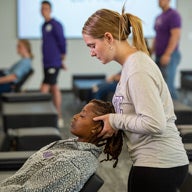


About the Chiropractic Profession
Chiropractic is a health care profession that focuses on the spine and other joints of the body, their connection to the nervous system, and overall patient health. Doctors of Chiropractic are primary care doctors who specialize in spinal health and well-being, maximizing patient function through conservative care. They assess, care for and guide patients toward better movement, less pain and stronger long-term health, without surgery or prescription medication as their primary tools.
In addition to adjustments, chiropractors also provide soft-tissue therapies, lifestyle recommendations, fitness coaching and nutritional advice.
Palmer College of Chiropractic was founded in 1897, just two years after D.D. Palmer performed the first chiropractic adjustment, and Palmer has trained more of the profession’s doctors than any other institution: more than one-third of all practicing Doctors of Chiropractic are Palmer graduates.
What Does a Chiropractor Do, Day to Day?
As a Doctor of Chiropractic, you’ll help your patients through exams, hands-on adjustment, soft tissue work and monitoring how their condition progresses. Many chiropractors also guide patients through corrective exercises, offer nutrition and lifestyle recommendations, and coordinate with other health care providers, physicians, physical therapists or specialists, when a patient’s care calls for a team approach. Chiropractors work with patients of nearly every age and activity level, from infants to older adults to elite athletes.
Beyond the clinical work itself, many chiropractors point to the career’s flexibility as a major draw. Because so many Doctors of Chiropractic go on to own their own practice, they set their own hours, build their patient schedule around their life rather than the other way around, and shape a practice that reflects their approach to patient care. That combination of meaningful patient relationships paired with real control over how and when you work is a big part of why chiropractic consistently ranks as a career people find personally fulfilling, not just professionally successful.
Who Sees a Chiropractor?
An estimated 50 million Americans see a chiropractor every year, according to Gallup. Patients most often seek chiropractic care for back and neck pain, headaches, and injuries from sports or everyday activity, though many also see a chiropractor as part of an ongoing wellness routine, for prevention and performance rather than pain alone.
The U.S. Bureau of Labor Statistics projects faster-than-average job growth for chiropractors over the next decade, and a growing share of that demand is tied to patients and providers looking for effective pain relief that doesn’t start with a prescription. As concern over opioid use and dependence has grown nationally, drug-free, hands-on approaches like chiropractic care have drawn increased attention from patients, physicians and health systems searching for safer first-line options for managing pain.
Becoming a Doctor of Chiropractic
Practicing chiropractic care requires a Doctor of Chiropractic (D.C.) degree, a rigorous doctoral-level program that combines classroom study with extensive hands-on clinical training.
At Palmer College of Chiropractic, the institution that pioneered chiropractic education in 1897, that training happens under faculty who lead the profession, inside the world’s largest chiropractic clinic network, with additional real-world experience available through opportunities like the DoD/VA Student Rotation Program. Every one of Palmer’s 2,000-plus students is pursuing the same Doctor of Chiropractic degree, so you’re surrounded by classmates and a campus built entirely around one goal.
The program typically takes three and one-third years, or ten trimesters, to complete, and Palmer builds board preparation directly into the curriculum: 94% of Palmer students pass all parts of the National Board of Chiropractic Examiners (NBCE) licensure exams within six months of graduation.
Explore What a D.C. Degree Can Do for You
Understanding chiropractic is the first step. Here’s where to go next:
- See where a Doctor of Chiropractic degree can take your career: Career Paths
- Learn what it takes to get into Palmer and start your D.C. degree: Admissions
- See what Palmer graduates report after graduation: Graduate Outcomes
What Is Chiropractic FAQ
What is chiropractic care used for?
Chiropractic care is most often used to address back and neck pain, headaches, and injuries from sports or everyday activity, along with broader movement, posture and wellness goals.
Is chiropractic care evidence-based?
Yes. Chiropractic education and practice rely on research evidence alongside clinical experience and patient preferences; an approach Palmer’s research programs and D.C. curriculum are built around. Palmer Center for Chiropractic Research is the largest and most highly-funded chiropractic research center in the nation, and this research continues to advance Palmer’s curriculum and the chiropractic profession.
Do chiropractors go to medical school?
No. Chiropractors earn a Doctor of Chiropractic (D.C.) degree through an accredited chiropractic college rather than a medical school (M.D. or D.O. program), though both are doctoral-level health care degrees requiring national board exams and state licensure.
How long does it take to become a chiropractor?
Earning a Doctor of Chiropractic degree typically takes three and one-third years of doctoral study, following completion of prerequisite undergraduate coursework.
Ready to Learn More?
The Trusted Leader in Chiropractic Education®
Request more information or visit a campus to get started.
Doctors of Chiropractic (D.C.) hold a first-professional doctoral degree earned through more than 4,200 hours of graduate-level coursework, clinical training, and laboratory work. They are licensed by every state in the U.S. following national board examinations, and they are recognized as physician-level providers under Medicare, Medicaid, and federal workers’ compensation programs.

Explore the 10 things you should consider when choosing a chiropractic school.

Becoming a Doctor of Chiropractic begins with learning the hands-on skills that will shape your career and impact your future patients. At Palmer College of Chiropractic, the place where the profession began, you’ll develop a deep, practical understanding of chiropractic techniques through early, immersive training and extensive clinical experience.