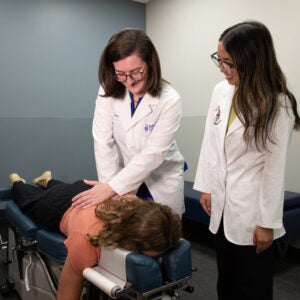
 Yes, a chiropractor is a real doctor. Doctors of Chiropractic (D.C.) hold a first-professional doctoral degree earned through more than 4,200 hours of graduate-level coursework, clinical training, and laboratory work. They are licensed by every state in the U.S. following national board examinations, and they are recognized as physician-level providers under Medicare, Medicaid, and federal workers’ compensation programs.
The chiropractic profession is growing faster than nearly any other health care field, integration into mainstream health systems is accelerating, and the evidence base continues to deepen. This is one of the most promising doctoral career paths in health care today.
What is a Doctor of Chiropractic?
A Doctor of Chiropractic (D.C.) is a doctoral-level health care professional trained to diagnose and treat disorders of the musculoskeletal and nervous systems, with particular expertise in the spine. The D.C. is a first-professional doctorate, the same class of credential as a D.D.S., O.D., or D.P.M.
Chiropractors are licensed in all 50 U.S. states and recognized as physician-level providers under federal law, including Medicare, Medicaid, and workers’ compensation programs. They practice across private clinics, multidisciplinary health systems, VA medical centers, military installations, and sports medicine settings.
| The scope of chiropractic practice includes physical examination and diagnosis, ordering and interpreting diagnostic imaging (X-ray, MRI, CT), developing and executing treatment plans, performing spinal manipulation and manual therapy, and providing rehabilitative and lifestyle guidance. |
How long is chiropractic school?
Chiropractic school typically takes four years of full-time doctoral study, following at least three years of undergraduate preparation, for a total educational pathway of seven or more years.
At Palmer College of Chiropractic, the D.C. program is 10 trimesters of year-round study. This structure allows students to progress through an integrated sequence of didactic instruction and supervised clinical practice, completing the degree in approximately three years and four months of continuous enrollment.
Before applying, most students have completed 90 or more undergraduate semester hours with coursework in biology, chemistry, physics and psychology. Strong academic preparation in the life sciences is foundational to success in the D.C. curriculum.
What does a Doctor of Chiropractic study?
The D.C. curriculum encompasses more than 4,200 hours of instruction, laboratory work, and supervised clinical experience across four areas:
- Basic Sciences: Anatomy, physiology, biochemistry, histology, embryology, microbiology, and pathology
- Clinical Sciences: Neurology, orthopedics, radiology, physical examination, differential diagnosis, and diagnostic imaging interpretation
- Chiropractic Sciences: Spinal and extremity anatomy, biomechanics, adjustive technique, and manual therapy across multiple chiropractic systems
- Patient Care: Case management, clinical reasoning, rehabilitation, nutrition, and practice in Palmer’s accredited teaching clinics
The Palmer Chiropractic Clinics, where students undergo their clinical training, is the largest network of chiropractic clinics in the world. Palmer’s teaching clinics serve diverse patient populations across multiple campuses, giving students high-volume, hands-on clinical experience under the guidance of highly-skilled, licensed Doctors of Chiropractic before they graduate.
Do chiropractors have to pass licensing exams?
Yes. chiropractors must pass the National Board of Chiropractic Examiners (NBCE) examinations, a four-part series covering basic sciences, clinical sciences, clinical competency and physiotherapy. All 50 states require NBCE board passage as a condition of licensure, and most require an additional state-specific examination or jurisprudence component.
Licensure is not a one-time event. Every state requires ongoing continuing education throughout a chiropractor’s career to maintain active licensure; the same standard applied to medical doctors, dentists, and other doctoral-level health care professionals.
Are chiropractors recognized by insurance and federal programs?
Yes. Chiropractic care is covered by Medicare, Medicaid, most major private insurance carriers, the Department of Veterans Affairs, TRICARE (the military health system), and federal and state workers’ compensation programs.
| The VA’s recognition is particularly significant: chiropractic care is now a Tier 1 integrative pain treatment modality within VA patient-centered care plans, meaning it’s recommended as a front-line treatment option, not a supplementary one. |
This designation reflects both the clinical evidence for chiropractic care and the federal government’s formal acknowledgment of chiropractors as essential health care providers in the treatment of chronic pain.
What does the research say about chiropractic care?
The clinical evidence supporting chiropractic care is substantial and growing. Key findings include:
| The Palmer Center for Chiropractic Research is the largest and most highly-funded chiropractic research effort in the United States. Palmer College researchers have led some of the field’s most significant clinical trials, including the NIH-funded VERDICT trial, one of the largest chiropractic clinical studies ever conducted, focused on veterans with chronic low back pain. Palmer faculty publish extensively in peer-reviewed journals on outcomes, quality measures, and integrative care, directly shaping evidence-based practice across the profession. |
What Conditions Do Chiropractors Treat?
Doctors of Chiropractic are trained to diagnose and address a wide range of conditions affecting the musculoskeletal and nervous systems. Their clinical scope extends well beyond back pain — encompassing the spine, extremities, and the interconnected network of nerves and soft tissues that influence how the body moves and functions.
A 2024 review of 33 clinical practice guidelines published in the Journal of Clinical Medicine identified the conditions for which spinal manipulative therapy — the primary chiropractic treatment — is most commonly recommended by evidence-based guidelines:
Spine and Back Conditions
- Low back pain — the most extensively studied area of chiropractic care, with spinal manipulation recommended in 90% of guideline statements reviewed. Includes acute, subacute, and chronic presentations, as well as pregnancy- and postpartum-related low back pain.
- Lumbar disc herniation and sciatica — chiropractic care is guideline-supported for lumbar radiculopathy, including radiating pain, numbness, and weakness associated with disc herniation and nerve root compression.
- Neck pain and cervical conditions — manipulation and mobilization are front-line recommendations for uncomplicated neck pain. Guidelines also support chiropractic care for cervical radiculopathy and whiplash-associated disorders.
- Thoracic spine conditions — mid-back pain and rib/thoracic joint dysfunction treated through manipulation and soft tissue techniques.
Headache Conditions
- Cervicogenic headaches — headaches originating from the cervical spine, for which chiropractic manipulation is specifically guideline-recommended.
- Tension-type headaches — spinal manipulation appears in multiple recent clinical practice guidelines as a recommended treatment option.
- Migraine — chiropractic care is increasingly included in multidisciplinary migraine management protocols, particularly for patients seeking non-pharmacologic approaches.
Extremity and Joint Conditions
- Shoulder pain — clinical guidelines now include chiropractic manipulation as a recommended option for shoulder pain, reflecting a growing body of evidence for extremity care.
- Hip, knee, and ankle conditions — joint dysfunction and pain in the lower extremities, including IT band syndrome, patellofemoral pain, and ankle sprains.
- Sports injuries — acute and overuse injuries affecting muscles, tendons, ligaments, and joints throughout the body, with particular depth of evidence in athletic populations.
- Work-related musculoskeletal disorders — repetitive strain, postural dysfunction, and occupational injuries, covered under workers’ compensation programs in all 50 states.
Other Conditions Within Chiropractic Scope
- Fibromyalgia — recent clinical practice guidelines have reversed earlier recommendations and now support spinal manipulation as a component of fibromyalgia management.
- Sacroiliac joint dysfunction — a common contributor to low back and pelvic pain, addressed through manipulation and soft tissue approaches.
- Pediatric musculoskeletal conditions — a 2024 chiropractic clinical practice guideline published in The Journal of Integrative & Complementary Medicine provides updated guidance for pediatric care within the chiropractic scope.
| Chiropractic diagnosis is not limited to treatment decisions. Doctors of Chiropractic are trained to recognize conditions outside their scope, including serious pathology such as fracture, infection, malignancy, and vascular conditions, and to refer patients to the appropriate provider. Clinical screening and differential diagnosis are core competencies of the D.C. curriculum. |
Where do chiropractors work?
Chiropractors practice across a wide range of settings, with expanding opportunities in institutional and integrated healthcare environments:
- Private and group practices: Many D.C.s build and own their own clinics, allowing chiropractors to be health care professionals and entrepreneurs.
- Multidisciplinary and integrative health clinics: Chiropractors work alongside physicians, physical therapists, and other providers
- Hospital-based departments: A growing segment of chiropractors work within hospital settings as major health systems expand conservative pain management
- VA medical centers: Chiropractic is embedded in VA care delivery nationally as a Tier 1 treatment
- Military installations: Serving active-duty personnel through TRICARE
- Sports medicine: With professional teams, collegiate programs, and performance clinics
- Academic and research institutions: In faculty, research, and clinical educator roles
More than 70,000 licensed chiropractors practice in the United States, and more than one-third of all practicing chiropractors are Palmer graduates.
Chiropractor salary and job outlook
The U.S. Bureau of Labor Statistics (BLS) projects 10% employment growth for chiropractors from 2024 to 2034, significantly faster than the average for all occupations. Approximately 2,800 to 3,100 chiropractic job openings are projected each year over the decade.
The Palmer Plexus Job Board (formerly Palmer CareerNetwork) posts more job openings each year than Palmer produces graduates — a consistent signal about market demand for Palmer-trained D.C.s and the career readiness of Palmer graduates.
Why earn your degree at Palmer College?
At Palmer College of Chiropractic, you don’t just earn a degree. You join the institution that defined the profession and continues to shape its future. As the first and largest chiropractic college in the world, Palmer has prepared more chiropractors than any other institution, setting the standard for excellence in education, research and patient care.
Palmer brings together more than a century of educational excellence, hands-on clinical depth, nationally recognized faculty expertise and the most robust chiropractic research enterprise in the nation. This integrated experience ensures you graduate not only prepared, but confident, capable and ready to lead.
Palmer graduates make an impact everywhere chiropractic is practiced. From private practice to major health systems, from research universities to federal settings, our alumni serve communities across all 50 states and around the world. As part of the largest and most connected alumni network in the profession, you gain access to a community that supports your growth long after graduation.
For more than 125 years, Palmer has set the benchmark for what it means to be a Doctor of Chiropractic: skilled, compassionate, evidence-informed and committed to advancing the health of the patients and communities we serve.