On any NFL game day this fall, somewhere near the sideline, there’s a chiropractor waiting for the player who comes off the field with an injury of some kind and needs evaluated. It’s a job plenty of Palmer students and graduates picture the day they arrive on campus or upon graduation, and with 32 teams in the NFL and only a chiropractor or two on each medical staff, it can look like the kind of job that only happens to someone else.
This season, 13 Palmer graduates work with NFL teams. Three of them have held that job for years: Stuart Yoss, D.C. (`95), with the Chicago Bears, Greg Kempf, D.C. (`94), with the Cleveland Browns, and Alan Sokoloff, D.C. (`85), with the Baltimore Ravens.
None of them walked out of Palmer and into an NFL locker room. Each built a practice first, three different kinds of practices, and each of those practices is what eventually led them to an NFL sideline.
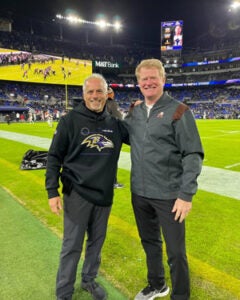 What makes their stories worth telling is how differently they got there. Dr. Sokoloff started out with the dream of working for an NFL team. Dr. Yoss knew he wanted to work in sports, starting with the gymnastics he’d competed in himself. Dr. Kempf never planned on it at all.
“It wasn’t my dream to do the sports team thing or anything,” says Dr. Kempf.
Yet all three tell the same story about how it happened, and it starts with the work they did in their own communities.
Build Where You Are
When Dr. Yoss talks to students about working in professional sports, his advice barely mentions the work he does with the pros.
“Become the sports medicine person in your community,” he says. “Maybe then you get a kid who is at the high school level and then goes to college. And every time he comes back from college, he’s going to come see you, and then he gets drafted.”
He built his own practice that way, going all in on Active Release Techniques (ART) until he was teaching it, and he tells students the goal is “focusing on your community and becoming the best sports chiropractor that way.”
In Cleveland, that meant straight chiropractic. Dr. Kempf’s downtown practice referred patients out for therapy and stuck to adjusting.
“You have to be really, really good at that manipulation,” he says, “because that’s what they’re looking for.”
After forty years into practice in Maryland, Dr. Sokoloff makes the same case from the other end. When he teaches, he thanks the chiropractors in the room for treating young athletes, because some of those kids become the pros he treats.
“If they’ve had chiropractic care all their lives, my job is easy,” he says. “I believe it starts in your community.”
It Takes Time
None of it happened quickly for Drs. Kempf, Sokoloff, or Yoss.
The Chicago Bears turned Dr. Yoss down more than once. By the mid-2000s, he’d worked on a Bears player at the team’s facility and on several more at his own office, and none of the work turned into a full-time gig initially. When one of the team’s most famous linebackers got hurt, he called the athletic trainer again and got a polite answer.
 “Look, thank you, but no. Everyone’s been calling us [with] what they think the answer is.”
Within a year, that answer would change.
“We’ll call you when we need you.” That’s how Dr. Kempf’s role with the Browns started, and it grew over several years, from once a week at the facility to twice a week, then game days, then traveling with the team.
“You have to be patient,” he says. “It doesn’t just happen overnight.”
Baltimore didn’t even have a team when Dr. Sokoloff opened his Maryland practice after graduating in 1985. The Colts had already left for Indianapolis, and the city wouldn’t get another NFL team until 1996, so he started at the college level and worked his way up.
“There were a lot of doors that closed along the way,” he says, “but you find a way and be persistent to get around them.”
The Door Opens Through People
When the breaks finally came, each one came through a person.
The year after the Bears told Dr. Yoss no, they hired a new strength coach who already knew ART. One day the strength coach called his office to ask if he could send a player over. The player was the same linebacker he’d been turned down to work on a year earlier. Not long after, the trainer who’d told him no called back to ask if he wanted to work with the team.
A Christmas party changed things for Dr. Kempf. The original Browns had left for Baltimore, and Cleveland was putting together a new team. At the party, Dr. Kempf met the new team’s head trainer, who believed the players were going to see a chiropractor whether the team had one or not, so he wanted one on staff. Staying, though, meant earning the trust of everyone else on the medical staff.
“You need to keep your ego in check, because you’re working with a lot of professionals,” says Dr. Kempf.
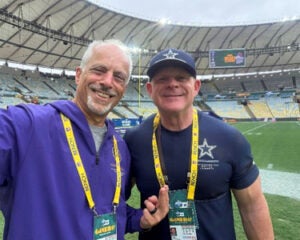 The Ravens came to Dr. Sokoloff the same way. His work at the Olympic Training Center led to the Goodwill Games and the Pan American Games, and the people he met there led to Baltimore. Early on, he learned from the chiropractors who’d worked in pro sports before him, and he says that mentorship mattered more than any technique.
“Find a mentor. Find somebody that’s been where you want to go,” says Dr. Sokoloff. “And everyone you meet along that journey, do not burn a bridge. In sports, the world is very small.”
The Dream Is Still a Job
Working with an NFL team doesn’t replace the practice. In many ways, it depends on it. Dr. Kempf works with the Browns as a contractor, not an employee, and most of the team chiropractors he knows around the league run private practices, too.
“I paid my bills through my private practice,” Kempf says. “People would come to me because they were like, well, the Browns trust you, then I’ll trust you.
Dr. Yoss is even more blunt: “The money that we make from working with these sports teams, I couldn’t even pay my bills.”
The reward is the work itself. Dr. Kempf calls the teamwork “fun,” the kind of thing that “keeps you engaged.” Dr. Yoss, 31 years into practice, is “still loving feeling the vertebrae move.” And Dr. Sokoloff says the satisfaction he gets from every level of sport is what has kept him going for four decades.
None of them would promise a student an NFL job. What they’d promise is that the work you do in your own community, done as well as you can do it, is a career worth building on its own. For three Palmer graduates, the road to an NFL sideline started in the same place, with a practice built one patient at a time.
Looking for someone who’s been where you want to go? Connect with alumni mentors through the Palmer Plexus.
Beyond the Gridiron
Their NFL work isn’t the whole story. Dr. Yoss, Dr. Kempf and Dr. Sokoloff have also cared for some of the biggest names in hockey, basketball and baseball.
A Stanley Cup clincher, 2015. Before Game 6 of the Stanley Cup Final, one of the Chicago Blackhawks’ forwards got hurt during the morning skate. Dr. Yoss worked on him, the player made it into the lineup, and the Blackhawks won the Cup that night on home ice. In the celebration afterward, head coach Joel Quenneville found Dr. Yoss in the locker room. “I don’t know what you did,” Quenneville told him, “but thank you.”
An MVP’s shout-out, 2012. In February 2012, Chicago Bulls Point Guard, Derrick Rose, missed five games with an injury. When he returned against the Hawks on Feb. 20, he scored 23 points, and in his on-court interview afterward he gave the credit to Dr. Yoss. “The whole week I was seeing a great chiropractor, Stuart Yoss,” Rose said, according to accounts published at the time. “He did a great job on getting me back.”
LeBron’s rookie year, 2003. When the Cleveland Cavaliers went looking for a chiropractor, they called the Browns and asked who they used. Dr. Kempf started with the Cavs that season, which happened to be LeBron James’ first in the NBA. “That’s more or less why they called me,” says Dr. Kempf. “They’re like, all right, we need everybody here.”
From the minors to the majors. Dr. Sokoloff spent 15 years with the Bowie Baysox, the Baltimore Orioles’ Double-A affiliate, before working his way up to the Orioles themselves, where he’s been for the last five years. “Each sport, each level of sport, provides me a different level of satisfaction,” he says.