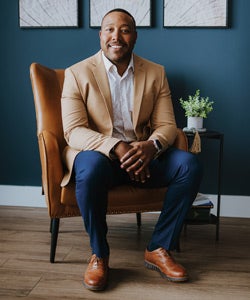
 Omar Clark, D.C., (’16) never planned on becoming a chiropractor. During his freshman year of college, he was driving to visit his grandmother in Richmond, Virginia, when the spare tire on his car collapsed. A driver behind him watched the car flip down an embankment five times.
Dr. Clark was thrown into the windshield. He left with staples in his head and headaches and migraines that would not let up. He saw a series of doctors and specialists, including neurologists. Their tests came back normal, but he knew something was wrong. Some days the pain was so bad he could barely drive.
“I knew I wanted to be a chiropractor after chiropractic saved my life,” he says.
Today Dr. Clark is a graduate of Palmer College of Chiropractic’s Florida campus and the owner of Experience Health and Wellness Center, a nearly 5,000-square-foot practice in a commercial plaza he built. Dr. Clark was even recently honored as one of Palmer College’s 2026 10-under-10 award winners!
The chiropractor who changed his path
One afternoon in a college health class, Dr. Clark looked down at his desk and felt pressure build behind his eyes. His heart raced and his palms began to sweat. He picked up the phone and called his brother, a chiropractor who was practicing in San Marino, Italy, at the time.
His brother pointed him to Ray Drury, D.C., in Charlotte, North Carolina. Dr. Clark made the drive with his friend Jazmin, who is now his wife. Dr. Drury explained the craniocervical junction, where the skull meets the top of the spine, and its role in communication between the brain and the body. Then he went to work.
“He gave me my life back,” Dr. Clark says. The two became close friends, and Dr. Drury’s daughters later served as flower girls in his wedding.
Dr. Clark did not head straight to chiropractic school. He finished his undergraduate degree, then a master’s degree, while he weighed which direction to take. “When I sat down and just reminisced and prayed on it, it rekindled the memory of what allowed me to continue to finish school, that’s when I realized that my call was to be a chiropractor,” he says.
A practice built to feel like family
 Dr. Clark’s practice has grown in stages. It opened as Experience Family Chiropractic, became Experience Family Chiropractic and Wellness Center, and is now Experience Health and Wellness Center.
The logo came first, sketched with his brother at a kitchen table. The X in “Experience” is formed with an anchor. “We want everyone to be anchored into health,” he says, “physically, mentally and spiritually.” The name carries a promise, too. Every person who walks in should have an experience, and the team cares for each patient the way they would care for their own mother, grandmother or child.
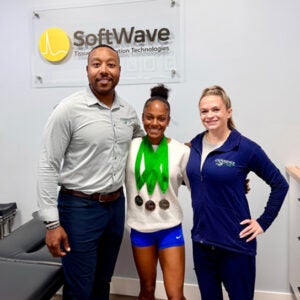
Chiropractic adjustments are the foundation of care. Dr. Clark uses Orthospinology, an upper cervical technique, along with Chiropractic BioPhysics analysis and full-spine imaging to decide how to help each patient. The office also offers spinal decompression, SoftWave therapy and red-light therapy.
His philosophy centers on patients taking an active role in their health. “We don’t want people to be a spectator with their health,” he says. “We want them to be a participator with their health.” For patients who have come to accept pain as permanent, the team has a saying: your abnormal is not your new normal.
A day in the life of being a Doctor of Chiropractic
Every morning starts with a team huddle. Doctors, case managers and front desk staff review the day’s patients, talk through complex cases and decide who will handle what. Once a week, the huddle becomes what the team calls a level 10 meeting, where each person shares a personal high from the past week and a high from the practice, such as a patient story that stuck with them. Each team member also brings a few words of wisdom to start the day. “We always have a saying,” Dr. Clark says. “We win in the morning, we win for the day.”
Then the doors open. Music plays through the office, and the front desk greets every patient by first name. Patients move into the adjusting bays or into SoftWave or decompression therapy, but the adjustment remains the center of the day. “That’s the most important thing we do in our office,” he says, “because the adjustment is the foundation.”
The atmosphere is lively, with team members giving high-fives in the hallways and sharing patient wins in a group Slack channel. When someone is having a hard week, a teammate posts a note and the office sends a card.
Some of the most important moments happen away from the adjusting table. Dr. Clark often sits with patients in the lobby, “knee to knee, elbow to elbow, eye to eye,” just to talk. “Sometimes we also see elderly in the community where they don’t have any other family in the area,” he says. “So the highlight of their day is coming to our office.”
Patients notice. Some drive 45 minutes to an hour for care, and a few fly in from Miami. “If you don’t have fun, if you don’t love what you do, then that’s a problem,” Dr. Clark says. “But we all have fun, and we love it.”
What owning a practice makes possible
Chiropractic is one of the few health care professions where doctors routinely own their practices. For Dr. Clark, that pairing of doctor and business owner is where the work becomes most meaningful.
He points out that the word doctor comes from the Latin word for teacher. He takes that role seriously, giving health talks in the community and educating patients in the office. Ownership gives him the freedom to decide how the practice shows up for its neighbors. “By being an entrepreneur as well, it just allows us to have the freedom to give back,” he says.
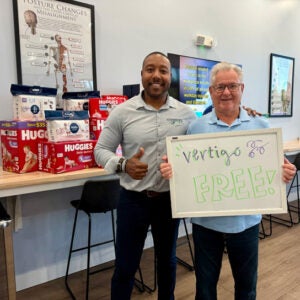 That freedom shows up all year. At Thanksgiving, the practice buys hundreds of pumpkin pies to give away. The “Bless a Bottom” diaper drive collects diapers & wipes for The New Beginnings Home, which supports single mothers. Patients and staff adopt a family at Christmas, pulling tags from a tree in the office and buying gifts.
During hurricane season in Florida, Dr. Clark opened his doors to people who needed a place to go. After one storm, the office served as a donation site. The team moved food and supplies to a location where boats carried them to families cut off when a bridge washed out.
Ownership also opened the door to real estate. Dr. Clark recently built a commercial plaza, where his wellness center fills one side, nearly 5,000 square feet, and two other businesses lease the remaining space.
He is candid that the path has hard days. “There are some moments where you ask yourself, ‘Oof, is it worth it?’ That’s the reality of it,” he says. “But it’s just a blessing.” He credits the business courses he took at Palmer with helping him build the foundation for all of it.
His advice for future chiropractors
Know your value. New graduates often doubt how much they can help, Dr. Clark says. He wants them to walk in with confidence. “Understand that you being able to provide chiropractic care is monumental in the lives that you can help and impact,” he says, “and help people just get their quality of life back.”
Get outside your four walls. “In order to grow, you have to get uncomfortable,” he says. He urges new doctors to attend ribbon cuttings, network and introduce themselves to other providers in the community, from physical therapists and acupuncturists to orthopedic specialists and neurosurgeons. When providers know each other, patients can make informed decisions and reach their goals faster. That applies whether you open your own practice or join one as an associate. “Get outside, show your face, shake hands, smile and build relationships within the community.”
Remember you are not alone. After graduation, classmates scatter and it is easy to feel isolated. Dr. Clark encourages new doctors to call their professors and colleagues when challenges come up. He also shares a formula he lives by: E + R = O, which means event plus response equals outcome. “No matter what event you deal with, you control how you respond, which dictates the outcome,” he says.
Above all, he wants graduates to lean on the community they built at school. “Always remember, we’re always Palmer Proud,” he says. “And if we have Palmer Pride, we should always lean into one another and utilize that network of other amazing doctors that have graduated from Palmer.”
Your path starts here
Dr. Clark’s career began with one chiropractor who took the time to explain what was happening in his body. Today he is the one explaining, adjusting and giving back, in a practice and a building he created.
If you are considering a career in health care and want to help people get their quality of life back, start with the Doctor of Chiropractic Program at Palmer College of Chiropractic. Explore the program and plan a visit.